
26 November 2026
English Translation:
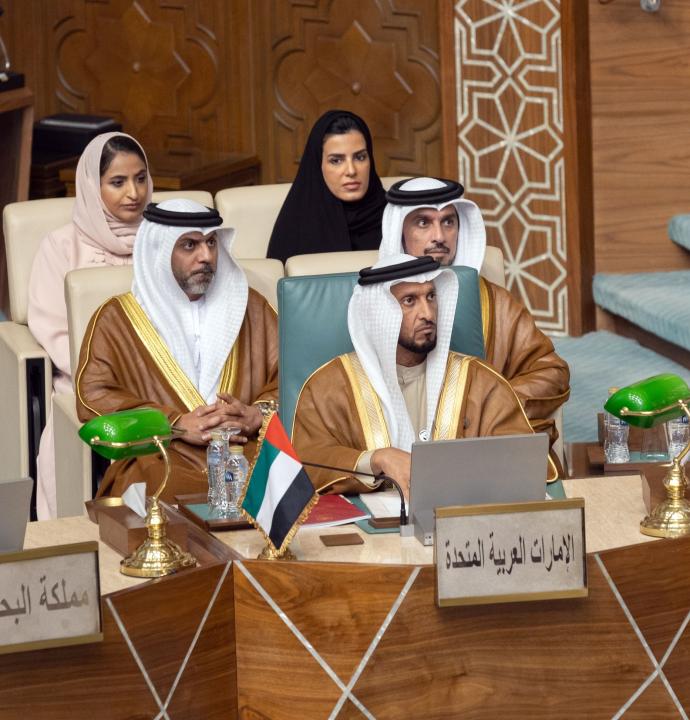
The United Arab Emirates won membership of the Executive Bureau of the Council of Arab Information Ministers during the Bureau’s meeting held at the headquarters of the General Secretariat of the League of Arab States in Cairo, reaffirming the UAE’s leading position in advancing Arab media work and its active role in shaping joint Arab media policies and initiatives.
This took place during the participation of the UAE delegation, headed by Abdullah bin Mohammed bin Butti Al Hamed, Chairman of the National Media Office and Chairman of the Board of the Emirates Media Council, in the 55th session of the Council of Arab Information Ministers, held at the General Secretariat headquarters in Cairo, in the presence of the Secretary-General of the League of Arab States, Ahmed Aboul Gheit.
Abdullah Al Hamed affirmed that this selection reflects the confidence the UAE enjoys on the Arab media scene and expresses the appreciation of member states for its efforts in strengthening joint Arab action, alongside its role in developing legislative frameworks that support responsible and innovative media capable of keeping pace with developments and anticipating the future.
He noted that the UAE will continue to leverage its advanced expertise in the service of Arab media work by supporting initiatives aimed at elevating content standards, empowering talents, and capitalising on the rapid pace of digital transformation, thereby contributing to building a more influential Arab media sector capable of meeting the demands of tomorrow.
Abdullah Al Hamed delivered the UAE’s address during the meeting, opening by conveying the greetings of the UAE’s wise leadership and their deep appreciation to Arab information ministers for their constructive efforts in serving the media mission and strengthening its role as an effective tool for spreading awareness, instilling values, and keeping pace with challenges and changes in the Arab and global arenas.
He stressed that the responsibility of Arab media today goes beyond the boundaries of traditional coverage and messaging to become an active force for development and stability, a guardian of identity, and a bridge connecting reality with the aspirations of peoples. In this context, he highlighted the importance of the Arab Media Charter of Honour, which represents an ethical and professional framework that reunites media practice around shared principles of truthfulness, fairness, and respect for human dignity. He emphasised that it is not merely a theoretical document, but a tool for enhancing professionalism and responsibility in media work.
Abdullah Al Hamed pointed out that, at its core, the Charter is not a restriction but a protection for the profession and a safeguard of the public’s right to access accurate information free from misinformation. He explained that its recent amendments complement this objective and reaffirm that Arab media must be a factor of stability and support for social cohesion, rather than a source of confusion or division among peoples.
The Chairman of the National Media Office stressed the need to redefine our relationship with digital media from a professional and ethical standpoint, noting that this space has become the most influential in shaping awareness and recognises no geographical boundaries.
He further noted that digital media today requires the development of a unified Arab vision that balances freedom of expression with content responsibility, protects audiences from the massive flow of rumours and disinformation, and restores the competitive presence of Arab media through platforms capable of producing knowledge.
Abdullah Al Hamed explained the necessity of investing in the Arab Committee for Electronic Media as a shared pool of expertise upon which joint policies and developments can be built, enabling the anticipation of future risks in the digital space rather than merely reacting to them. He underscored the importance of enhancing Arab cooperation to confront the challenges of digital media and achieve sustainable positive impact within Arab societies.
In his address, he also touched on the role of Arab media in confronting terrorism, stressing that combating terrorism is fundamentally a battle of awareness before it is a battle on the ground. He noted that extremist organisations realised early on that controlling minds is more effective than battlefields, leading them to exploit social media platforms and spread violent rhetoric in subtle and insidious ways.
He affirmed that Arab media bears a decisive responsibility in dismantling terrorist propaganda, exposing the hollowness of its discourse, and highlighting the human and religious values that honour life and reject extremism and fanaticism.
He stressed that this responsibility requires unifying media messages, strengthening cooperation among institutions, and investing in the latest technological tools for early detection of extremist campaigns and depriving them of the environments in which they thrive. He emphasised that every word matters in confronting extremism, every delay is costly, and every silence leaves space for forces of darkness to fill the void.
Abdullah Al Hamed clarified that no reform or renaissance path can be built without developing the capabilities of Arab media professionals, stressing that quality is not merely a slogan but an integrated system of work that begins with serious training, extends to the development of production tools, and culminates in an environment that rewards creativity and holds accountability for shortcomings.
He added that Arab media today is required to be a researcher, analyst, investigator, and content creator at the same time, stressing that achieving this equation necessitates the establishment of joint Arab programmes for professional empowerment, strengthening partnerships among institutions, and setting clear standards of excellence that measure competence rather than titles alone.
He also addressed the need to employ advanced technologies in Arab media and their impact on the human element, noting that the deeper transformation imposed by artificial intelligence on the media landscape is not a threat to the human element as much as it is a test of institutions’ ability to adapt. He pointed out that while machines lack conscience yet excel in performance, humans remain the holders of vision and meaning.
He concluded by emphasising that the goal is not to fear technology, but to employ it wisely through establishing safeguards that protect privacy, ensure transparency, and prevent abusive uses that could turn media into a coordinated chaos driven by algorithms devoid of conscience.